ATS vs. AI Scoring: The Technical Differences That Impact Your Hiring Quality
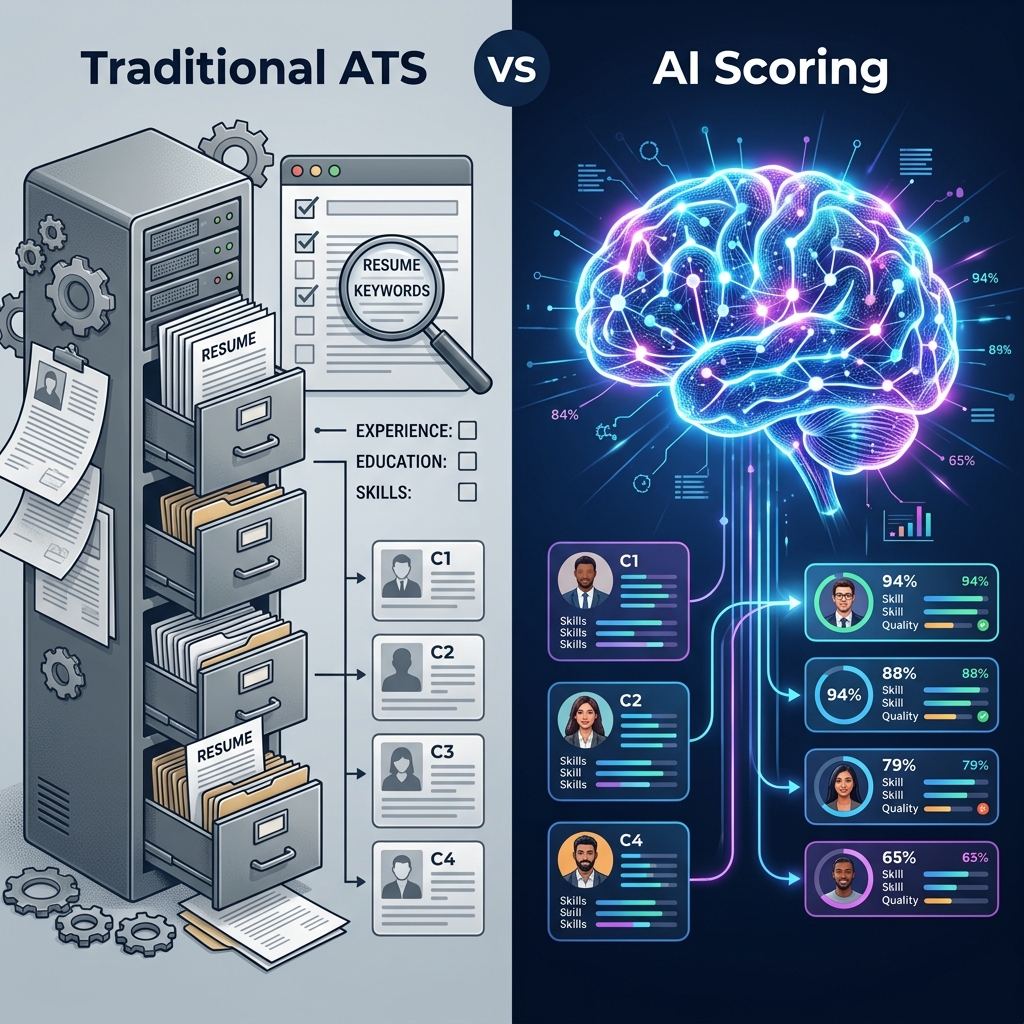
For over twenty-five years, the Applicant Tracking System (ATS) has been the digital backbone of the recruitment industry. But for the last five, it has been its biggest productivity killer. In 2026, the distinction between "Tracking" and "Scoring" has become the difference between surviving and thriving in talent acquisition. If you are still relying on an ATS to filter your candidates, you are almost certainly auto-rejecting 20% of your most qualified talent.
A Brief History of the ATS: From Filing Cabinet to Filter
The first generation of ATS (1990s) were glorified spreadsheets. Their goal was storage. The second generation (2010s) introduced "Keyword Matching" to solve the volume problem. But keyword matching was built on a flawed assumption: that a resume is a database. It isn't. A resume is a narrative of impact, and narrating impact doesn't always involve repeating a specific tag.
Today, we are in the era of Deep Semantic Recruitment. Using the same Large Language Model (LLM) architectures that powered GPT-4, we can finally move beyond word-counting and into meaning extraction. If an ATS is a librarian looking for a specific book title, AI Scoring is a scholar who has read every book and can explain how they are related.
The 30-Year Evolution: From Storage to Intelligence
- Phase 1: The Digital File Cabinet (1995-2005): Systems like Taleo were built to solve one problem: "Where is the resume?" They were databases for storage, not evaluation.
- Phase 2: The Keyword Filter (2005-2018): As volume increased, recruiters needed a way to cull the list. Systems introduced "Boolean Search." This worked when resumes were standardized, but failed as the "Gig Economy" and "Skill-Based Hiring" emerged.
- Phase 3: The Black Box AI (2018-2024): Early AI attempts tried to predict "Performance" based on "Past Hires." However, this simply encoded the company's existing biases into a hidden algorithm.
- Phase 4: Deep Semantic Scoring (2025+): This is where EvalMetric lives. We don't look at "Who you hired before." We look at "What is the meaning of this candidate's work?"
The Death of Boolean: Why Keywords Are Failing You
Boolean search is binary. It's an "All or Nothing" game. If you search for "React Developer" + "TypeScript," you miss the "Senior Frontend Engineer" who architected massive UI libraries using "Modern JS supersets." These candidates are often senior-level talent who focus on describing their high-level impact rather than listing every buzzword in their bio.
By relying on keyword filters (the basis of platforms like Workday and Recruiters.com), you are essentially forcing candidates to play an "SEO Game." This creates a perverse incentive: the candidates who are best at gaming your filters get the interview, while the candidates who are best at doing the job are often auto-rejected.
"We discovered a pattern where our highest-performing hires over the last 3 years all had one thing in common: they would have failed our ATS keyword filtering today. They were leaders who didn't feel the need to list every technology they touched, assuming their titles and impact spoke for themselves."
— Head of Recruitment, Global Consultancy
The Semantic Shift: How Vector Scoring Understands Merit
AI Scoring engines like EvalMetric use a process called Vector Embedding. We map every resume and every job description into a multi-dimensional mathematical space. In this space, "Data Science," "Machine Learning," and "Predictive Modeling" are physically close together.
When the AI "reads," it evaluates:
- Functional Identity: Not just what they know, but who they are as a professional. The AI can distinguish between a "Project Manager" in construction vs. one in software development.
- Impact Depth: The system understands the difference between "Helped with a budget" and "Owned a $50M budget with 15% YoY efficiency gains."
- Skill Evolution: The AI recognizes growth. A candidate who started as an intern and rose to Lead in 3 years is ranked higher than one who has been at the same level for a decade.
The Hidden Talent Problem: The 20% Tax on Hiring
Our internal data revealed a devastating statistic: 20.4% of candidates who were rated "Highly Qualified" by human recruiters had been auto-rejected by at least one major ATS keyword filter.
| Capability | Traditional ATS (Workday, etc.) | EvalMetric AI Scoring |
|---|---|---|
| Search Logic | Exact Keyword / Boolean | Deep Semantic Identity |
| Processing Spirit | Filtering (Finding reasons to say No) | Discovery (Finding reasons to say Yes) |
| Shortlisting | Manual (Recruiter reads the hits) | Automated (AI ranks the hits) |
| Multilingual | Fragile (requires translation) | Native (Arabic, French, etc.) |
| Bias Mitigation | None (unconscious bias in search strings) | Calibrated (Active mitigation of proxies) |
Expert Deep-Dive: Frequently Asked Questions
How is AI Scoring different from "CV Parsing"?
Old-school CV parsing just extracts text into fields. AI Scoring actually synthesizes that text to understand its value.
Does this increase the cost per hire?
Actually, it drastically reduces it. Most firms save 60-70% in recruiter labor time and reduce "Time-to-Hire" by 20+ days.
Can I integrate this with Greenhouse or Workday?
Yes. We offer seamless integrations where you can forward candidate emails to our engine, and we push the scores back into your ATS dashboard via API.

Abdessamad OUTkidoute
Founder & Lead Recruitment Engineer
Abdessamad helps GCC and global talent acquisition teams scale rapidly through transparent, highly calibrated AI parsing systems designed for enterprise equity.
Connect on LinkedIn →Related Articles
The Anti-Black-Box Manifesto: Why Transparent AI is the Future
Discover why hidden algorithms are ruining hiring and how EvalMetric is leading the charge for explainable, ethical, and unbiased AI candidate scoring.
Bulk Resume Screening: How to Filter 1,000+ CVs in Seconds with AI
Manual resume screening costs enterprises $4,129 per hire. Learn how AI bulk screening processes 1,000+ CVs in 90 seconds with 98.4% consistency — and why traditional ATS keyword filters miss 20% of top talent.
Ready to elevate your hiring?
Join modern teams who have eliminated manual screening bias. Get your first 10 credits free.
Start Evaluation→